



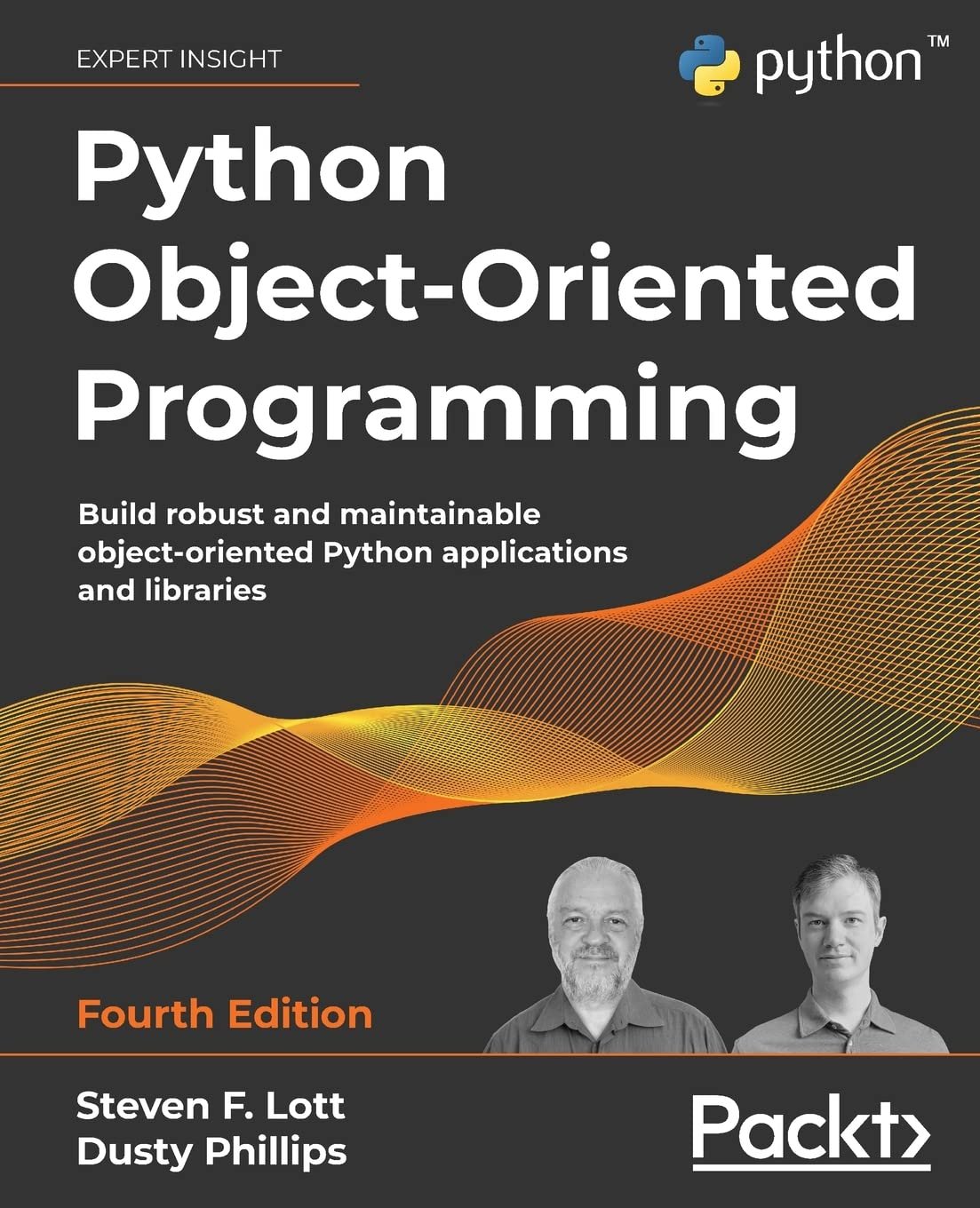



Python Object-Oriented Programming – Fourth Edition: Build robust and maintainable object-oriented Python applications and libraries
Original price was: ₹3,699.00.₹2,901.00Current price is: ₹2,901.00.
Price: ₹3,699 - ₹2,901.00
(as of Mar 30, 2026 01:51:17 UTC – Details)
A comprehensive guide to exploring modern Python through data structures, design patterns, and effective object-oriented techniques
Key Features:
Build an intuitive understanding of object-oriented design, from introductory to mature programs Learn the ins and outs of Python syntax, libraries, and best practices Examine a machine-learning case study at the end of each chapter
Book Description:
Python Object-Oriented Programming, Fourth Edition dives deep into the various aspects of OOP, Python as an OOP language, common and advanced design patterns, and hands-on data manipulation and testing of more complex OOP systems. These concepts are consolidated by open-ended exercises, as well as a real-world case study at the end of every chapter, newly written for this edition. All example code is now compatible with Python 3.9+ syntax and has been updated with type hints for ease of learning.
Steven and Dusty provide a friendly, comprehensive tour of important OOP concepts, such as inheritance, composition, and polymorphism, and explain how they work together with Python’s classes and data structures to facilitate good design. UML class diagrams are generously used throughout the text for you to understand class relationships. Beyond the book’s focus on OOP, it features an in-depth look at Python’s exception handling and how functional programming intersects with OOP. Not one, but two very powerful automated testing systems, unittest and pytest, are introduced in this book. The final chapter provides a detailed discussion of Python’s concurrent programming ecosystem.
By the end of the book, you will have a thorough understanding of how to think about and apply object-oriented principles using Python syntax and be able to confidently create robust and reliable programs.
What You Will Learn:
Implement objects in Python by creating classes and defining methodsExtend class functionality using inheritanceUse exceptions to handle unusual situations cleanlyUnderstand when to use object-oriented features, and more importantly, when not to use themDiscover several widely used design patterns and how they are implemented in PythonUncover the simplicity of unit and integration testing and understand why they are so importantLearn to statically type check your dynamic codeUnderstand concurrency with asyncio and how it speeds up programs
Who this book is for:
If you are new to object-oriented programming techniques, or if you have basic Python skills and wish to learn how and when to correctly apply OOP principles in Python, this is the book for you. Moreover, if you are an object-oriented programmer coming from other languages or seeking a leg up in the new world of Python, you will find this book a useful introduction to Python. Minimal previous experience with Python is necessary.
Publisher : Packt Publishing
Publication date : 2 July 2021
Edition : 4th ed.
Language : English
Print length : 714 pages
ISBN-10 : 1801077266
ISBN-13 : 978-1801077262
Item Weight : 1 kg 210 g
Dimensions : 19.05 x 4.09 x 23.5 cm
Country of Origin : India
Best Sellers Rank: #121,662 in Books (See Top 100 in Books) #37 in Object-Oriented Design #74 in Python Programming #94 in C & C++ Programming
Customer Reviews: 4.4 4.4 out of 5 stars (114) var dpAcrHasRegisteredArcLinkClickAction; P.when(‘A’, ‘ready’).execute(function(A) { if (dpAcrHasRegisteredArcLinkClickAction !== true) { dpAcrHasRegisteredArcLinkClickAction = true; A.declarative( ‘acrLink-click-metrics’, ‘click’, { “allowLinkDefault”: true }, function (event) { if (window.ue) { ue.count(“acrLinkClickCount”, (ue.count(“acrLinkClickCount”) || 0) + 1); } } ); } }); P.when(‘A’, ‘cf’).execute(function(A) { A.declarative(‘acrStarsLink-click-metrics’, ‘click’, { “allowLinkDefault” : true }, function(event){ if(window.ue) { ue.count(“acrStarsLinkWithPopoverClickCount”, (ue.count(“acrStarsLinkWithPopoverClickCount”) || 0) + 1); } }); });


Matthew –
Note to Publisher
Dear Packt,I have found an awesome content inside the book. But the quality of the binding I received from the publisher is unacceptable. Its not the first time, i encountered the issue.Pl don’t spoil the journey of reading awesome content just because of your poor quality of presentation.BR,Matthew
Chinmay –
Quality from Amazon is perhaps not a valid expectation
Wow such a great book. I am enjoying it page by page
Mert –
I recently delved into “Responsive Web Design with HTML5 and CSS”, and it has profoundly enriched my understanding of contemporary web development practices. This book stands out for its thorough coverage and approachable writing style.Content and StructureThe author presents complex concepts in a friendly and informal manner, making the material accessible without compromising depth. The latest edition encompasses recent advancements in responsive web design, including enhanced user accessibility, variable fonts and font loading, and CSS Scroll Snap. Each topic is elucidated with clear explanations, practical examples, and visual aids, facilitating a seamless learning experience.Practical ApplicationWhat sets this book apart is its emphasis on hands-on application. Readers are encouraged to engage with interactive exercises and real-world projects, reinforcing the theoretical knowledge acquired. This pragmatic approach ensures that learners can confidently implement responsive design principles in their own work.Conclusion”Responsive Web Design with HTML5 and CSS” is an invaluable resource for both novices and seasoned developers aiming to stay abreast of the evolving web landscape. Its blend of comprehensive content, engaging presentation, and practical insights makes it a must-have reference for anyone committed to mastering responsive web design.
gianluca –
Per imparare a muoversi su oop in python, un libro intuitivoLo consiglio
Vlad Bezden –
Like all books by Steven F. Lott, this book is no exception. I read all books by Steven, and I always learn something from them. Besides teaching how to write OOP and use it, this book explains how to write OOP code using modern data types like NamedTuple, TypedDict, tuples, etc.As always, I learned excellent tips and techniques on how to write nice tests. There are also very interesting chapters on Concurrency and Design Patterns.My only complaint is the type of examples provided in this book. Examples are complicated, and they are based on machine learning data, sailing data, etc. So to understand an example, sometimes you need to understand the domain knowledge of the example. I wish examples were simpler to get a concept and then maybe provide more complex examples.Steven is not biased to OOP in this book, but he also explains the difference between OOP and functional programming and teaches where OOP would be the best fit.In any way, it’s an excellent book, and I learned a lot from it, and I use it as a reference if I need to find an answer to my questions.
Carlos Cardona –
Despite its unfortunate initialism, POOP is money well spent. If you already have some experience with python, this book will take you to a next level in Python programming, and teach you along the way some good practices, how to improve readability and some common useful design patterns. Thumbs up!
E. Ohana –
1-There are enough typed and strongly typed languages in the world, there’s really no need to clutter Python with these type hints and mypy … the beauty and cleanliness of Python is one of the many reasons people go for it2- Sorry but the k-NN example seems too incongruous throughout the book, it was more of an hindrance to understanding for me3- The English is not always good in some places and the book could have done with a bit more proofreadingI’ll stick with Dusty’s 3rd edition, pity I missed the return window