



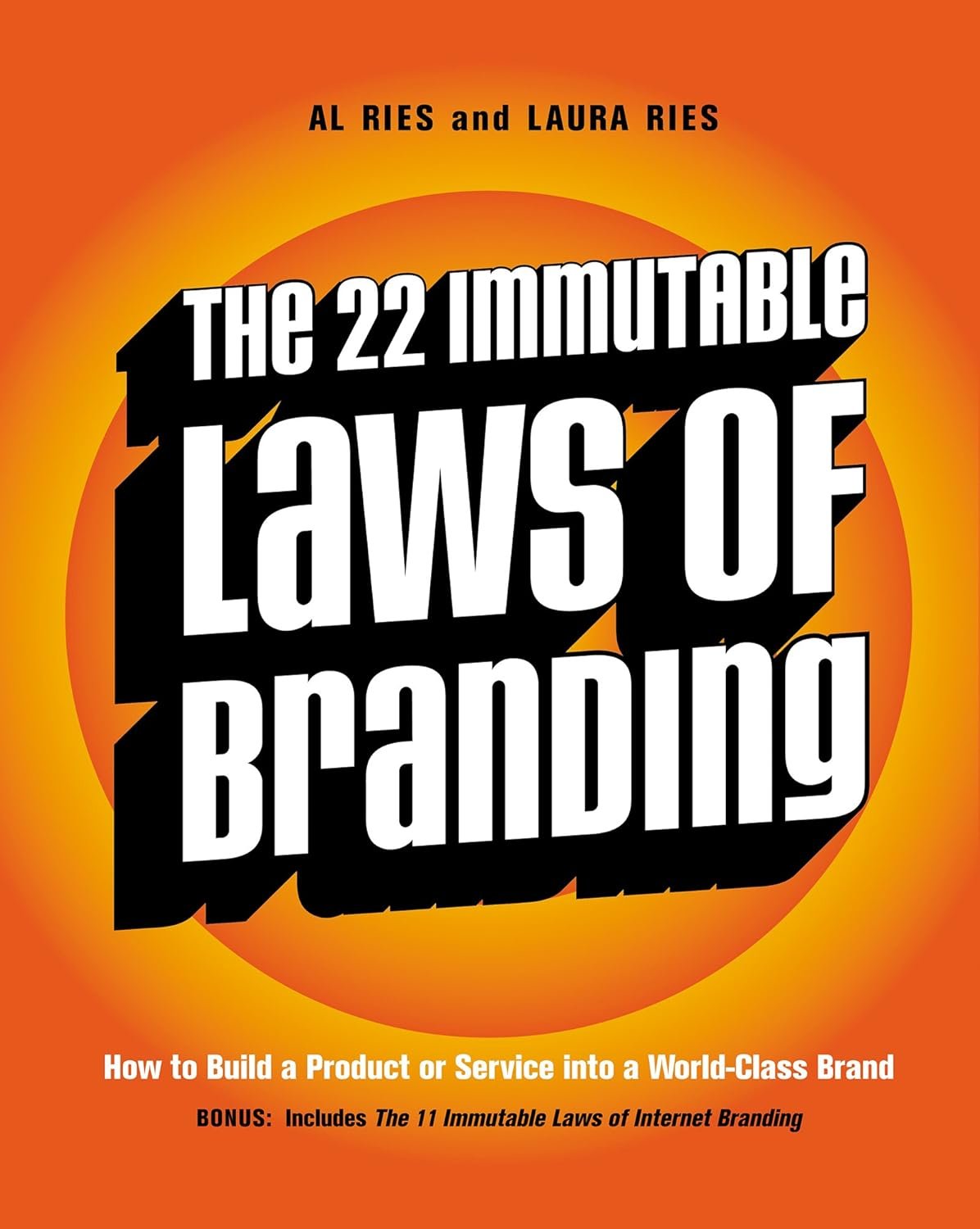



The 22 Immutable Laws of Branding: How to Build a Product or Service into a World-Class Brand
₹1,490.00
Price: ₹1,332.83 - ₹1,490.00
(as of Aug 08, 2025 13:47:23 UTC – Details)
This marketing classic has been expanded to include new commentary, new illustrations, and a bonus book: The 11 Immutable Laws of Internet Branding
Smart and accessible, The 22 Immutable Laws of Branding is the definitive text on branding, pairing anecdotes about some of the best brands in the world, like Rolex, Volvo, and Heineken, with the signature savvy of marketing gurus Al and Laura Ries. Combining The 22 Immutable Laws of Branding and The 11 Immutable Laws of Internet Branding, this book proclaims that the only way to stand out in today’s marketplace is to build your product or service into a brand—and provides the step-by-step instructions you need to do so.
The 22 Immutable Laws of Branding also tackles one of the most challenging marketing problems today: branding on the Web. The Rieses divulge the controversial and counterintuitive strategies and secrets that both small and large companies have used to establish internet brands. The 22 Immutable Laws of Branding is the essential primer on building a category-dominating, world-class brand.
ASIN : B000FC10H0
Publisher : Harper Business; 1st edition (6 October 2009)
Language : English
File size : 771 KB
Screen Reader : Supported
Enhanced typesetting : Enabled
X-Ray : Not Enabled
Word Wise : Enabled
Print length : 216 pages
Best Sellers Rank: #20,935 in Kindle Store (See Top 100 in Kindle Store) #3 in Sales eTextbooks #3 in International Business eTextbooks #6 in Business Development eTextbooks
Customer Reviews: 4.6 4.6 out of 5 stars 1,308 ratings var dpAcrHasRegisteredArcLinkClickAction; P.when(‘A’, ‘ready’).execute(function(A) { if (dpAcrHasRegisteredArcLinkClickAction !== true) { dpAcrHasRegisteredArcLinkClickAction = true; A.declarative( ‘acrLink-click-metrics’, ‘click’, { “allowLinkDefault”: true }, function (event) { if (window.ue) { ue.count(“acrLinkClickCount”, (ue.count(“acrLinkClickCount”) || 0) + 1); } } ); } }); P.when(‘A’, ‘cf’).execute(function(A) { A.declarative(‘acrStarsLink-click-metrics’, ‘click’, { “allowLinkDefault” : true }, function(event){ if(window.ue) { ue.count(“acrStarsLinkWithPopoverClickCount”, (ue.count(“acrStarsLinkWithPopoverClickCount”) || 0) + 1); } }); });
Customers say
Customers find the book informative, with many noting it’s full of examples. They appreciate its readability, with one customer describing it as an entertaining read.







Ashil Thomas –
Very Informative
Have completed a few chapters so far and I find it really informative. Lot of tips n tricks we can understand from each chapter.
Anonymous –
Good
Good
Shivani –
Good book
Good quality we received
Doll –
You must have this book
A must have book for learning branding insights.
eye-rate –
I highly recommend this book to any brand manager who has several …
Short, but packed full of insights and examples of right and wrong ways major companies have approached their branding processes and strategies. Makes for an entertaining but at the same time thought-provoking read. I highly recommend this book to any brand manager who has several products in his portfolio.
Amit Bhattacharjee –
It takes u back to the basics.
We work with these laws everyday but why are these laws used is what is clearly mentioned in the book.
Prem Verma –
Best Book Ever on Branding.
This book lots of deep knowledge on concept of Branding. I highly recommend this for business people.
BALDEO PANDEY –
Printing and paper quality
Printing and paper quality is not very good.
Rabri –
Me parece un libro muy interesante, fácil y rápido de leer, con muchos ejemplos útiles, aunque se repite un poco habiendo leído antes “The 22 Immutable Laws of Marketing” del mismo autor.
martin nel –
Well worth reading, and although written a number of years ago, I still find it useful in getting the all-important topic of branding right. This book is useful whether you are a big company or a one-man show. The most useful theme for me is the need to focus in terms of products or services. They give great examples of mega famous companies who got it right – and who got it wrong and lost their focus.Their initial predictions on convergence held true for many years, although these days where media and channels are in fact merging may mean that that is open to debate, however their immutable laws still seem to hold.Highly accessible and readable with plenty of practical suggestions.
Martin Turner –
How can a book which has almost no pictures be the ultimate introduction to branding?I was highly sceptical, and only added it onto to my list of branding books to buy because it was cheap. How wrong I was.In 172 readable, small-paperback pages, Al Ries and his daughter Laura unveil the fundamentals of branding, stripping away the most powerful myths and demonstrating with a mixture of brand successes, failures, falls and rises, that they know what they are talking about. What’s more, what they say made sense of many things I have been dimly feeling towards in my 20 years as a communications professional.I suspect that this book oversells itself slightly. The title made me suspicious, and the definitiveness of statements which go against what you find in other books makes you wonder, at points, if what it’s saying is really this cut and dried. I probably would have disregarded this book if I’d read it ten years ago: but practical industry experience convinces me that what it is saying is right, and the other books, which focus on choosing your name and redesigning the logo, are the ones which only understand a part of the picture.It took me about an hour and a half to read this book, and I will never see branding the same way again. That’s good value for you. On the other hand, I probably won’t be reading and re-reading it avidly. It makes its points, which can be quickly revised from the chapter headings. Now it’s time to move on.I would recommend this book to anyone and everyone who wants (or needs) to learn about branding. I can’t imagine a better introduction to the subject for someone who already has enough industry experience to recognise what it is talking about. I wouldn’t recommend anyone to _only_ read this book: it is an extremely sound beginning, not an encyclopaedia.In terms of what this book is trying to be, I don’t think there could be any higher recommendation than that.Superb.
Ting L –
I’ve completed reading “The 22 Immutable Laws of Branding” and “Positioning”. Both books are among the most thought-provoking works I’ve encountered on brand strategy.While reading “The 22 Immutable Laws of Branding”, I found the chapter on the Law of Divergence to be somewhat disconnected from modern branding realities. According to the book, categories tend to diverge as markets evolve, and convergence often results in brand dilution or failure. Yet, Amazon and the iPhone are two of the most successful brands today — both of which appear to contradict that claim. After some reflection, I believe the real issue isn’t about convergence versus divergence. Instead, it’s about branding strategy. My Conclusion: If a brand already holds a dominant position in one market, it can successfully expand into an adjacent or broader market — even one that appears to be a convergence or line extension — by creating and owning a new category in the prospect’s mind, especially when no dominant player yet exists in that space.Case in Point: iPhoneThe iPhone merged multiple functions — music player, video player, phone, social media, browser etc. — which on the surface seems to violate the Law of Divergence. But Apple didn’t market it as a mash-up of old categories. Instead, it positioned the iPhone as a breakthrough product in a new category: smartphones. At the time, there was no dominant smartphone brand in the minds of consumers. Apple claimed that space and won.Case in Point: AmazonAmazon began with a focused, divergent position as the world’s largest online bookstore. Over time, it expanded to sell electronics, clothing, groceries, and more. According to a strict interpretation of divergence theory, this kind of expansion under a single brand should have weakened its identity. But it didn’t — because no other brand had claimed leadership in e-commerce. Amazon filled that gap and successfully repositioned itself as “the everything store,” leading a new category: online commerce.Final Thought:So, the key isn’t convergence or divergence alone. It’s about category creation, brand leadership, and timing. When a brand can reposition itself into a new category and occupy a leadership position in the customer’s mind — even if it combines previously separate functions — it can still win.Great books! These books transformed me into a new addict of positioning and branding.
Sergio –
Great/must addition to your knowledge bag