



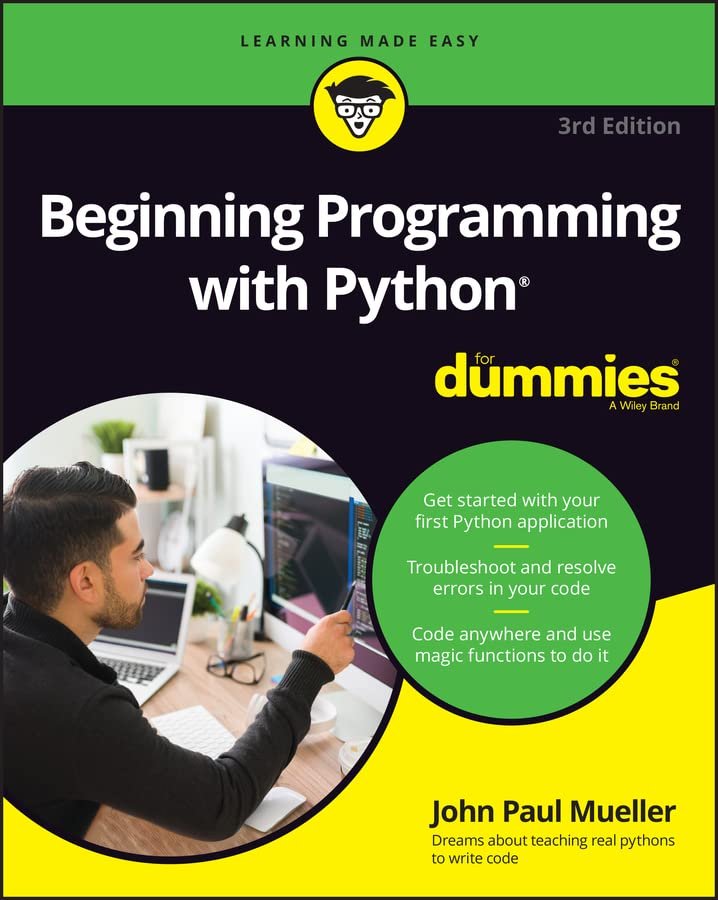



Beginning Programming with Python For Dummies
Original price was: ₹628.95.₹353.41Current price is: ₹353.41.
Price: ₹628.95 - ₹353.41
(as of Oct 02, 2025 19:52:03 UTC – Details)
Create simple, easy programs in the popular Python language
Beginning Programming with Python For Dummies is the trusted way to learn the foundations of programming using the Python programming language. Python is one of the top-ranked languages, and there’s no better way to get started in computer programming than this friendly guide. You’ll learn the basics of coding and the process of creating simple, fun programs right away. This updated edition features new chapters, including coverage of Google Colab, plus expanded information on functions and objects, and new examples and graphics that are relevant to today’s beginning coders. Dummies helps you discover the wealth of things you can achieve with Python.
Employ an online coding environment to avoid installation woes and code anywhere, any time Learn the basics of programming using the popular Python language Create easy, fun projects to show off your new coding chops Fix errors in your code and use Python with external data sets
Beginning Programming with Python For Dummies will get new programmers started—the easy way.
ASIN : B0BNCJGGHK
Publisher : For Dummies; 3rd edition (24 November 2022)
Language : English
File size : 9.3 MB
Screen Reader : Supported
Enhanced typesetting : Enabled
X-Ray : Not Enabled
Word Wise : Not Enabled
Print length : 385 pages
Page numbers source ISBN : 1119913772
Best Sellers Rank: #219,672 in Kindle Store (See Top 100 in Kindle Store) #199 in Software Design & Engineering eTextbooks #211 in Programming Languages eTextbooks #644 in Python Programming
Customer Reviews: 4.2 4.2 out of 5 stars 15 ratings var dpAcrHasRegisteredArcLinkClickAction; P.when(‘A’, ‘ready’).execute(function(A) { if (dpAcrHasRegisteredArcLinkClickAction !== true) { dpAcrHasRegisteredArcLinkClickAction = true; A.declarative( ‘acrLink-click-metrics’, ‘click’, { “allowLinkDefault”: true }, function (event) { if (window.ue) { ue.count(“acrLinkClickCount”, (ue.count(“acrLinkClickCount”) || 0) + 1); } } ); } }); P.when(‘A’, ‘cf’).execute(function(A) { A.declarative(‘acrStarsLink-click-metrics’, ‘click’, { “allowLinkDefault” : true }, function(event){ if(window.ue) { ue.count(“acrStarsLinkWithPopoverClickCount”, (ue.count(“acrStarsLinkWithPopoverClickCount”) || 0) + 1); } }); });


Ben Weston –
This book is very well written and is extremely thorough. I would say that despite the look of the book cover (looks a bit like a kiddies book), the content is very high quality and quite advanced. The author provides a corresponding GitHub repo which includes all code from the book – which again, is very well developed and presented in a highly professional manner. You simply read through each book chapter and run the GitHub examples in your own Colab setup to ‘play’ along.However, the overwhelming aspect of the book contents isn’t really Python, despite what the book title tells you! This is a book about Google Colab – Google’s own browser-based IDE. Although Colab is for running Python in your browser, this book really just uses Python as the vehicle for teaching the reader about Colab.So if you want a comprehensive lesson in the basics of Python, this book is not it – however, if you want a comprehensive overview of the notebook format of modern IDEs (which Colab is – effectively a Jupyter Notebook based, browser based IDE) then this is the book for you.Sidenote: For some reason this author doesn’t even follow PEP 8 code conventions for Python, which is a bit odd.
Adam Beeblebrock –
good
Peter Lee –
The book explains well, but the index at the back of the book is very poor. When I forget to go back to look up a function, frequently, it is not found. Even a common function like “groupby“ is not in the lndex.
GCR –
There are few books like this revision of his earlier book that covered Anaconda. But he does cover f-strings in this edition. if you are new to Python and to programming either editions are good books to read. The source code for the book examples are useful to save time.The author uses the unusual camel-case notation and does not seem to know how to keep permanent files in Colab when handling files. He has too little on functions.